Appealing a Financial Aid Award
March 17, 2026
College admissions offers are here, and with them, financial aid awards. No matter how generous the award, chances are good that you’re still thinking, “Wow, this is EXPENSIVE!” If that’s you, here’s some good news: It’s OK to ask for more.
More good news: about 3/4 of financial aid appeals result in the student receiving additional aid, according to Sallie Mae’s How America Pays for College. And yet, less than half of families appeal their aid award. There’s no harm in appealing: any college that has admitted your student wants them to attend, and asking for more money won’t change that.
Even more good news: One of the requirements of FAFSA Simplification is that colleges MUST review financial aid appeals. They are not required to offer you more money, but they are required to review your situation. Your odds of success will be better if you understand both the type of aid you’re being offered and the process for appealing.
If you have need-based aid, the appeals process is called Professional Judgement (PJ). The Higher Education Act allows schools the “authority to make adjustments, on the basis of documentation, to allow for treatment of an individual with special circumstances.” Note that schools have the requirement to review and authority to make changes, not the obligation. With the FAFSA (and CSS Profile) based on prior-prior year income and your aid award being based on those submissions, it goes without saying that plenty of families find themselves in a different financial position than what’s reflected on their FAFSA and Profile.
Special circumstances that commonly result in larger awards include loss of a job or other declines in income; divorce or separation; death of a parent; unreimbursed medical, dental or dependent care costs; catastrophic losses such as from natural disasters; and termination of alimony, child support or Social Security benefits to the student; unusual business or investment losses; or disability of the student or a parent.
PJ has some specific requirements:
- Any changes must be supported with documentation. That may include confirmation of a job loss, current investment account statements showing lower balances, receipts from medical care, etc.
- Financial aid administrators can modify elements of the Student Aid Index formula (such as income, assets or medical expenses) but not the formula itself.
- Like all need-based financial aid, PJ is for a single school year. If your current circumstances make your first-choice school completely unaffordable, remember that every year you will have to reapply so now could be a good time to reconsider the school overall.
And of course remember that aid awards are subject to the school’s aid packaging, which may include loans and work study in addition to grants. So a student who initially did not receive any aid might appeal and receive a direct student loan as their aid award.
Merit awards offer schools far more flexibility, since these are the school’s own dollars that they can use as they see fit. Here are some steps you can take to increase your chances of a successful appeal:
- Research the school’s merit aid policies so that you are approaching the appeal based on the school’s policies. For example, a student who finds that a nominally higher GPA would have yielded a much larger scholarship might appeal on the basis of having chosen a more academically-rigorous course load.
- Research the school’s overall financial aid policies and awards on a site like the College Board or Collegedata. That will give you a sense of what the school offers and on what criteria.
- Provide copies of aid awards from other, comparable schools who are offering you more. Many colleges will happily provide a few thousand extra dollars if they have reason to believe that will get you to accept and come on board for the next four years. Remember, if they don’t fill their freshman class, they’ll have empty seats for the next four years.
- Appeal in writing, with a polite letter that both expresses gratitude for what’s already been offered and provides a detailed rationale for why you deserve more. And of course, the appeal letter must be written by the student though of course the parent should supply the supporting documentation.
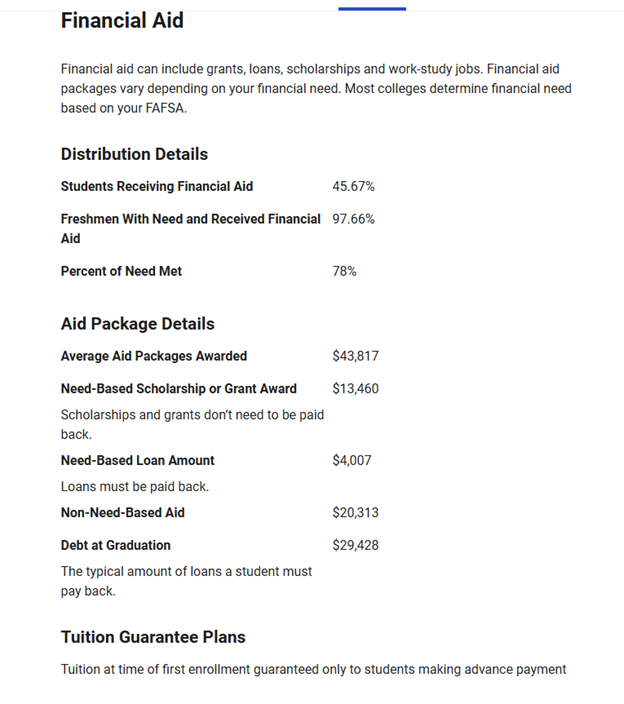
How do you do this research? There is a ton of data online that can help. Here is an example from the College Board website’s Costs tab (for Gonzaga). As you can see, Gonzaga offered aid to almost all students who were judged to have need, but only met an average of 78% of need. That means that if your Student Aid Index was $20,000 less than Cost of Attendance, you would likely only get $15,600 in aid. In addition, you can see that aid packages typically include a student loan and potentially also a merit scholarship.
Another interesting place to look on the College Board website is the school’s Admissions tab. Here you can see that almost half of students had GPAs of 3.75% or higher; the orange SAT scores are the 25th-75th percentile scores. That means that if your GPA is 3.75 or higher or your test scores are higher than the numbers in orange, you might be able to secure a larger merit scholarship.

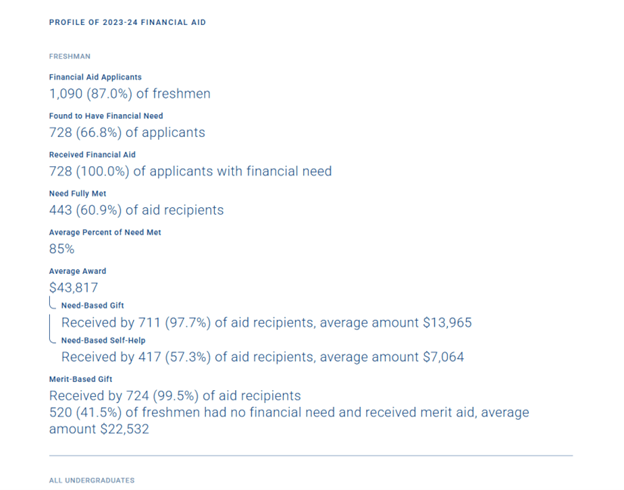
Here’s Gonzaga’s data set from Collegedata, which shows that all students with financial need received a merit award, and that the average merit award for students without financial need was $22,532.
There is one group of schools where it’s hard to appeal successfully: public colleges. Your best bet at a public college is usually to show that you might have been eligible for a larger merit award if the award were calculated differently. For example, if the college uses unweighted GPA to award merit scholarships and the student took a full load of advanced classes that resulted in an unweighted GPA just below the threshold, an appeal might succeed. In many cases, though, public colleges are helpful in directing students to other scholarships that can help fill gaps in their budget.
Bottom Line
Whether you’re appealing on need-based or merit grounds, the worst they can say is no — and even that won’t affect your admission. Start with a clear, documented case, be polite and specific, and submit as early as possible. Many schools have priority dates for PJ appeals (often April 1 for the following fall), so don’t wait.
Need more help?
Contact The Mather Group, your advisor, health insurance professional, or your state’s health insurance assistance program (SHIP) for additional information. SHIP is a national program that offers one-on-one Medicare counseling and assistance to individuals and their families.


College admissions offers are here, and with them, financial aid awards. No matter how generous the award, chances are good that you’re still thinking, “Wow, this is EXPENSIVE!” If that’s you, here’s some good news: It’s OK to ask for more.
More good news: about 3/4 of financial aid appeals result in the student receiving additional aid, according to Sallie Mae’s How America Pays for College. And yet, less than half of families appeal their aid award. There’s no harm in appealing: any college that has admitted your student wants them to attend, and asking for more money won’t change that.
Even more good news: One of the requirements of FAFSA Simplification is that colleges MUST review financial aid appeals. They are not required to offer you more money, but they are required to review your situation. Your odds of success will be better if you understand both the type of aid you’re being offered and the process for appealing.
If you have need-based aid, the appeals process is called Professional Judgement (PJ). The Higher Education Act allows schools the “authority to make adjustments, on the basis of documentation, to allow for treatment of an individual with special circumstances.” Note that schools have the requirement to review and authority to make changes, not the obligation. With the FAFSA (and CSS Profile) based on prior-prior year income and your aid award being based on those submissions, it goes without saying that plenty of families find themselves in a different financial position than what’s reflected on their FAFSA and Profile.
Special circumstances that commonly result in larger awards include loss of a job or other declines in income; divorce or separation; death of a parent; unreimbursed medical, dental or dependent care costs; catastrophic losses such as from natural disasters; and termination of alimony, child support or Social Security benefits to the student; unusual business or investment losses; or disability of the student or a parent.
PJ has some specific requirements:
- Any changes must be supported with documentation. That may include confirmation of a job loss, current investment account statements showing lower balances, receipts from medical care, etc.
- Financial aid administrators can modify elements of the Student Aid Index formula (such as income, assets or medical expenses) but not the formula itself.
- Like all need-based financial aid, PJ is for a single school year. If your current circumstances make your first-choice school completely unaffordable, remember that every year you will have to reapply so now could be a good time to reconsider the school overall.
And of course remember that aid awards are subject to the school’s aid packaging, which may include loans and work study in addition to grants. So a student who initially did not receive any aid might appeal and receive a direct student loan as their aid award.
Merit awards offer schools far more flexibility, since these are the school’s own dollars that they can use as they see fit. Here are some steps you can take to increase your chances of a successful appeal:
- Research the school’s merit aid policies so that you are approaching the appeal based on the school’s policies. For example, a student who finds that a nominally higher GPA would have yielded a much larger scholarship might appeal on the basis of having chosen a more academically-rigorous course load.
- Research the school’s overall financial aid policies and awards on a site like the College Board or Collegedata. That will give you a sense of what the school offers and on what criteria.
- Provide copies of aid awards from other, comparable schools who are offering you more. Many colleges will happily provide a few thousand extra dollars if they have reason to believe that will get you to accept and come on board for the next four years. Remember, if they don’t fill their freshman class, they’ll have empty seats for the next four years.
- Appeal in writing, with a polite letter that both expresses gratitude for what’s already been offered and provides a detailed rationale for why you deserve more. And of course, the appeal letter must be written by the student though of course the parent should supply the supporting documentation.
How do you do this research? There is a ton of data online that can help. Here is an example from the College Board website’s Costs tab (for Gonzaga). As you can see, Gonzaga offered aid to almost all students who were judged to have need, but only met an average of 78% of need. That means that if your Student Aid Index was $20,000 less than Cost of Attendance, you would likely only get $15,600 in aid. In addition, you can see that aid packages typically include a student loan and potentially also a merit scholarship.
Another interesting place to look on the College Board website is the school’s Admissions tab. Here you can see that almost half of students had GPAs of 3.75% or higher; the orange SAT scores are the 25th-75th percentile scores. That means that if your GPA is 3.75 or higher or your test scores are higher than the numbers in orange, you might be able to secure a larger merit scholarship.
Here’s Gonzaga’s data set from Collegedata, which shows that all students with financial need received a merit award, and that the average merit award for students without financial need was $22,532.
There is one group of schools where it’s hard to appeal successfully: public colleges. Your best bet at a public college is usually to show that you might have been eligible for a larger merit award if the award were calculated differently. For example, if the college uses unweighted GPA to award merit scholarships and the student took a full load of advanced classes that resulted in an unweighted GPA just below the threshold, an appeal might succeed. In many cases, though, public colleges are helpful in directing students to other scholarships that can help fill gaps in their budget.
Bottom Line
Whether you’re appealing on need-based or merit grounds, the worst they can say is no — and even that won’t affect your admission. Start with a clear, documented case, be polite and specific, and submit as early as possible. Many schools have priority dates for PJ appeals (often April 1 for the following fall), so don’t wait.
Need more help?
Contact The Mather Group, your advisor, health insurance professional, or your state’s health insurance assistance program (SHIP) for additional information. SHIP is a national program that offers one-on-one Medicare counseling and assistance to individuals and their families.





.png)



.avif)
.png)
.png)