Geopolitical Events and Market Volatility
March 18, 2026
We wanted to take a moment to address the recent market volatility stemming from heightened geopolitical tensions in the Middle East, including the U.S. and Israeli strikes on Iran and subsequent retaliatory actions. While these events have introduced short-term uncertainty, particularly around oil supplies and energy prices, we are closely monitoring developments and remain focused on your long-term financial goals.
Periods like this understandably generate concern. Markets often respond quickly when geopolitical tensions rise as investors assess potential economic implications. At the same time, volatility is a natural feature of financial markets, and historically periods of uncertainty have often been followed by strong long-term returns.
The developments underway are serious and continue to evolve. Our role is not to comment on the geopolitical dynamics themselves, but to help our clients understand how periods of uncertainty can influence financial markets and long-term investment outcomes.
When market volatility temporarily pressures valuations, it can create opportunities to add high-quality investments at more attractive prices. Historically, these environments have often contributed to stronger long-term portfolio outcomes as markets stabilize and economic fundamentals reassert themselves.
What history tells us about geopolitical shocks
With nearly a century of U.S. market data available, geopolitical conflicts have consistently created short-term market fluctuations but have not altered the long-term trajectory of market growth.
Analysis of geopolitical events between 1940 and 2022 shows a consistent pattern:
- Markets may experience modest declines in the first three months following geopolitical shocks.
- By six months, equity market returns have historically aligned with long-term averages.
- Over a twelve-month period, returns following geopolitical events have generally mirrored long-term market performance.
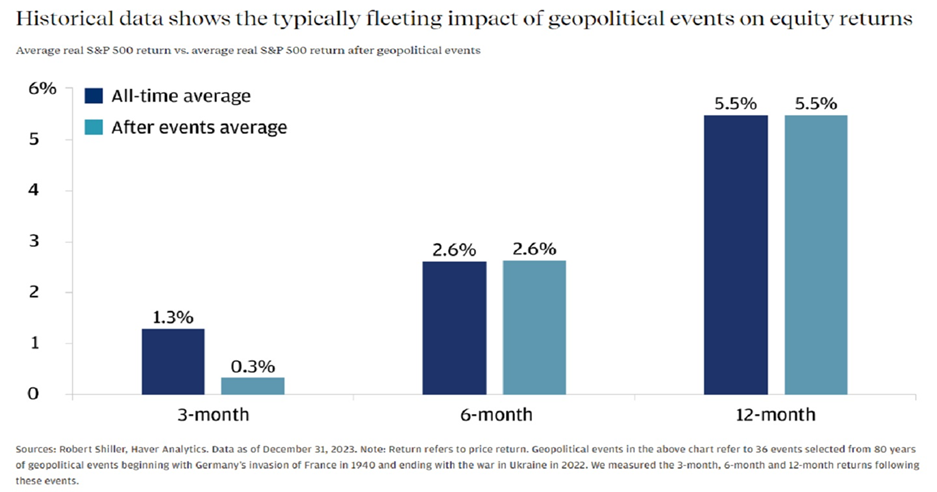
In other words, geopolitical shocks tend to influence markets in the short term, while long-term returns remain driven by economic growth, corporate earnings, and innovation.
Perspective from major geopolitical events
Major geopolitical developments, including wars and international conflicts, often create uncertainty that leads to short-term volatility as investors reassess risk and seek stability.
Historical market outcomes provide important context.
Over the past 75 years:
- The S&P 500 has delivered positive returns in most twelve-month periods following major geopolitical events.
- The average one-year return following these events has been approximately 14.2 percent.
- The few negative periods were tied primarily to broader economic forces, including
- The unwinding of the technology bubble in 2001
- The interest-rate driven market adjustment in 2022.
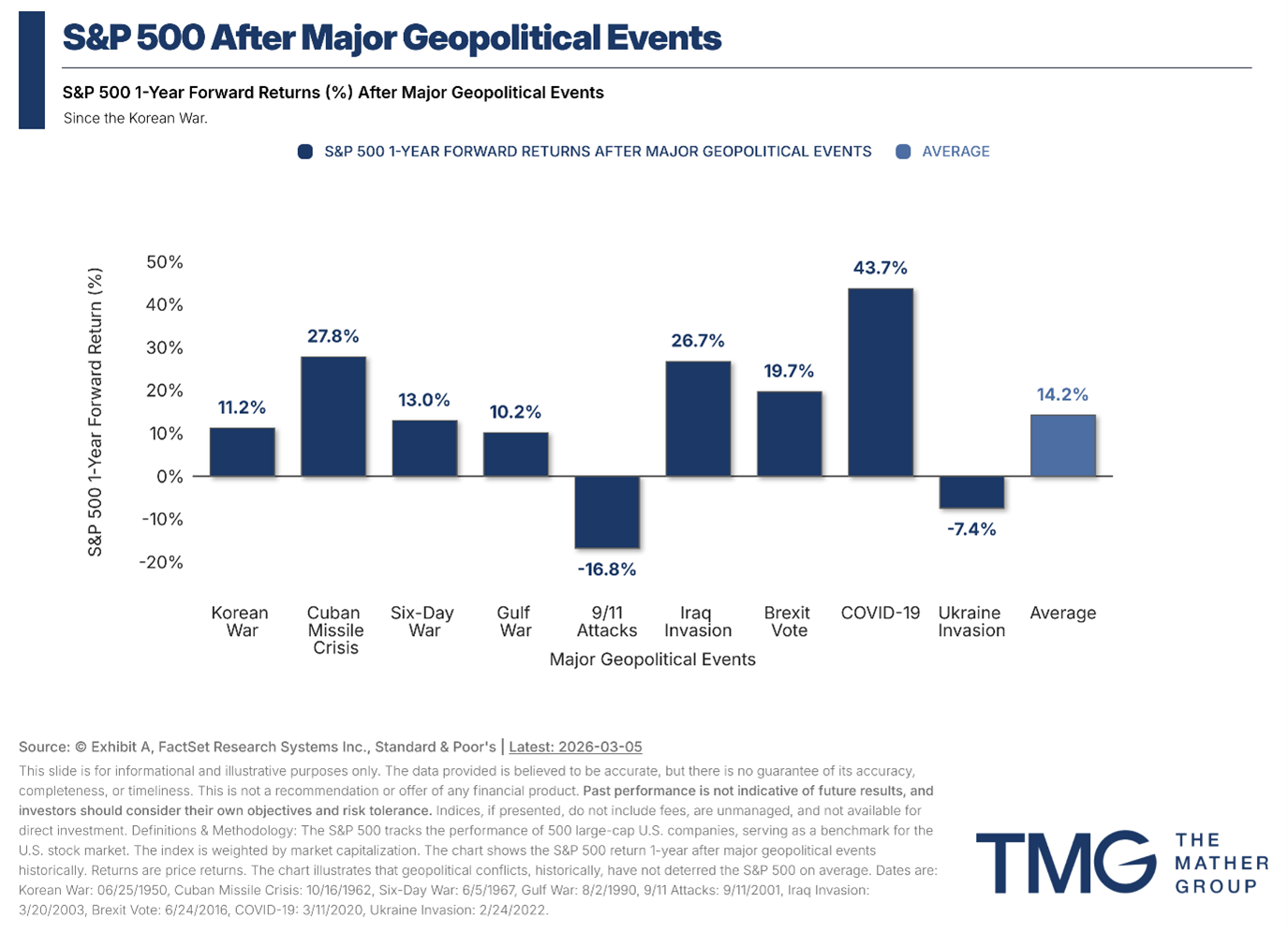
Even during periods of significant global uncertainty, markets have historically demonstrated resilience and continued long-term growth.
Why today’s energy environment is different
Some comparisons have been made to past energy crises such as the 1973 oil embargo. However, today’s global energy landscape differs significantly.
- The United States is now one of the world’s largest energy producers.
- Global energy supply chains are more diversified.
- Energy markets are structurally more flexible than in previous decades.
While oil prices may fluctuate in the near term, the structural vulnerabilities that existed during earlier energy shocks are significantly reduced.
How diversified portfolios navigate volatility
Periods of uncertainty reinforce the value of disciplined portfolio construction.
- Diversification across asset classes, sectors, and regions helps absorb unexpected shocks.
- Risk levels are intentionally managed within long-term investment strategies.
- Market volatility can create opportunities to add strong businesses at more attractive valuations.
Our role is to remain disciplined during both calm markets and uncertain ones. Short-term disruptions are part of the investing journey, but long-term progress has historically been driven by patience, diversification, and thoughtful risk management.
Need more help?
Contact The Mather Group, your advisor, health insurance professional, or your state’s health insurance assistance program (SHIP) for additional information. SHIP is a national program that offers one-on-one Medicare counseling and assistance to individuals and their families.


We wanted to take a moment to address the recent market volatility stemming from heightened geopolitical tensions in the Middle East, including the U.S. and Israeli strikes on Iran and subsequent retaliatory actions. While these events have introduced short-term uncertainty, particularly around oil supplies and energy prices, we are closely monitoring developments and remain focused on your long-term financial goals.
Periods like this understandably generate concern. Markets often respond quickly when geopolitical tensions rise as investors assess potential economic implications. At the same time, volatility is a natural feature of financial markets, and historically periods of uncertainty have often been followed by strong long-term returns.
The developments underway are serious and continue to evolve. Our role is not to comment on the geopolitical dynamics themselves, but to help our clients understand how periods of uncertainty can influence financial markets and long-term investment outcomes.
When market volatility temporarily pressures valuations, it can create opportunities to add high-quality investments at more attractive prices. Historically, these environments have often contributed to stronger long-term portfolio outcomes as markets stabilize and economic fundamentals reassert themselves.
What history tells us about geopolitical shocks
With nearly a century of U.S. market data available, geopolitical conflicts have consistently created short-term market fluctuations but have not altered the long-term trajectory of market growth.
Analysis of geopolitical events between 1940 and 2022 shows a consistent pattern:
- Markets may experience modest declines in the first three months following geopolitical shocks.
- By six months, equity market returns have historically aligned with long-term averages.
- Over a twelve-month period, returns following geopolitical events have generally mirrored long-term market performance.
In other words, geopolitical shocks tend to influence markets in the short term, while long-term returns remain driven by economic growth, corporate earnings, and innovation.
Perspective from major geopolitical events
Major geopolitical developments, including wars and international conflicts, often create uncertainty that leads to short-term volatility as investors reassess risk and seek stability.
Historical market outcomes provide important context.
Over the past 75 years:
- The S&P 500 has delivered positive returns in most twelve-month periods following major geopolitical events.
- The average one-year return following these events has been approximately 14.2 percent.
- The few negative periods were tied primarily to broader economic forces, including
- The unwinding of the technology bubble in 2001
- The interest-rate driven market adjustment in 2022.
Even during periods of significant global uncertainty, markets have historically demonstrated resilience and continued long-term growth.
Why today’s energy environment is different
Some comparisons have been made to past energy crises such as the 1973 oil embargo. However, today’s global energy landscape differs significantly.
- The United States is now one of the world’s largest energy producers.
- Global energy supply chains are more diversified.
- Energy markets are structurally more flexible than in previous decades.
While oil prices may fluctuate in the near term, the structural vulnerabilities that existed during earlier energy shocks are significantly reduced.
How diversified portfolios navigate volatility
Periods of uncertainty reinforce the value of disciplined portfolio construction.
- Diversification across asset classes, sectors, and regions helps absorb unexpected shocks.
- Risk levels are intentionally managed within long-term investment strategies.
- Market volatility can create opportunities to add strong businesses at more attractive valuations.
Our role is to remain disciplined during both calm markets and uncertain ones. Short-term disruptions are part of the investing journey, but long-term progress has historically been driven by patience, diversification, and thoughtful risk management.
Need more help?
Contact The Mather Group, your advisor, health insurance professional, or your state’s health insurance assistance program (SHIP) for additional information. SHIP is a national program that offers one-on-one Medicare counseling and assistance to individuals and their families.





.png)



.avif)
.png)
.png)